
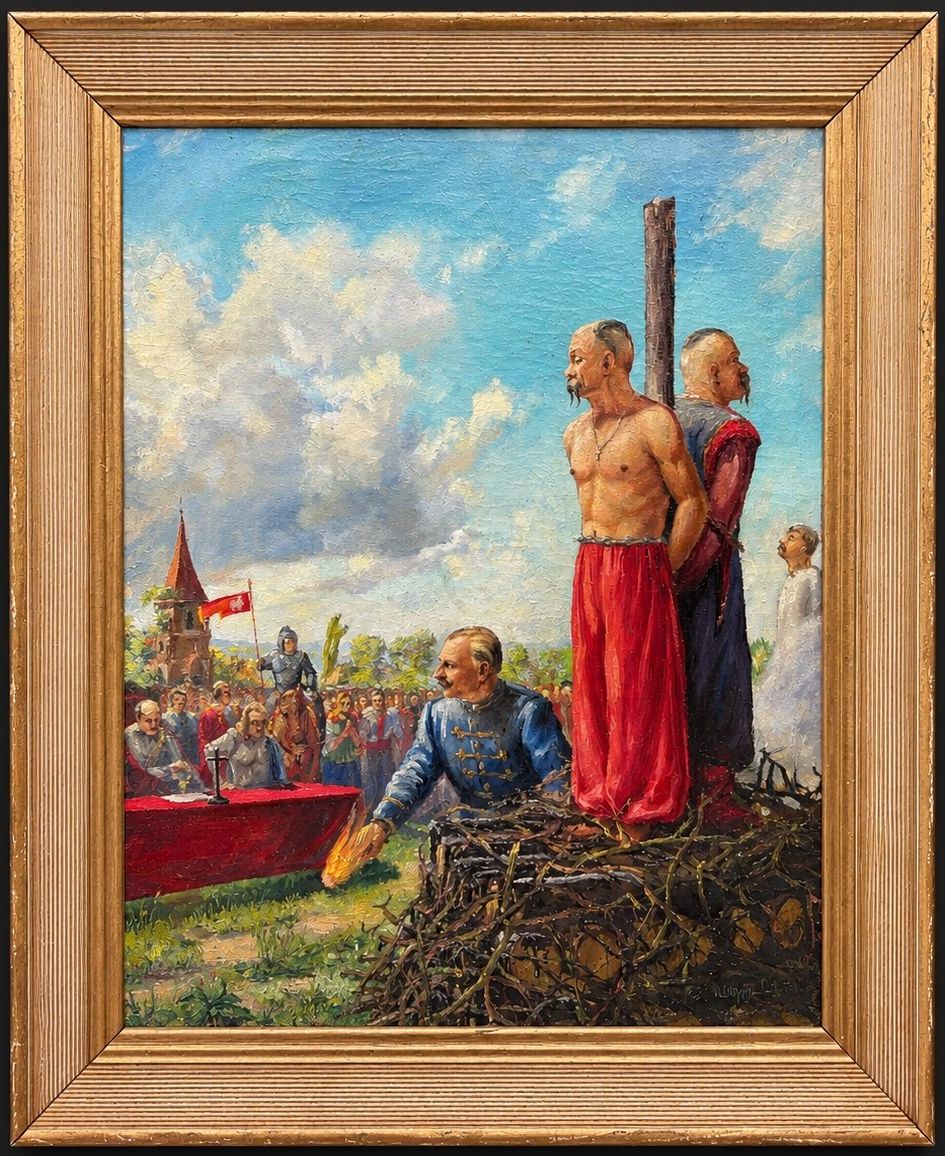
“Kozatska dolia. Kodnia.”
Oliia. 1947
“Kozak’s Fate. Kodnia.”
Oil. 1947
Kozatska dolia was painted by Wadym Dobrolige in 1947 when Wadym, his wife Valentyna, their daughter Natalia, and one of Natalia’s grandmothers were spending three years (1945-48) at Heidenau DP camp in Germany.
Kodnia is a village approximately 17 kilometres south of Zhytomyr. In 1768, the Koliivshchyna uprising around Kyiv, Cherkasy, Podillia, Bratslav, and Volyn regions, arising from the difficult circumstances of serfdom and religious oppression, was led by Maksym Zaliznyak and Ivan Gonta. After initial successes by the Ukrainian Haidamaks and Cossacks, Russian troops created a ruse. By feigning support for the Orthodox population, the Russians were able to detain some of the Haidamak leaders and hand them over to Polish authorities. The captured rebels ended up in Kodnia, where a special judicial body was created. Only one of the tribunal’s documents survived; it recorded over 200 death sentences, but researchers believe over 3000 Ukrainian rebels were eventually put to death either by decapitation, hanging, quartering, or death at the stake. Additionally, suspected supporters of the rebels often had limbs cut off as a warning to others.
Folk songs, legends, and Taras Shevchenko’s famous poem “Haidamaky” are devoted to the Koliivshchyna uprising.
Visit our Fine Arts collection page to see more beautiful artworks stored in the museum.